

The 4-Mark Secret: How to Study Smarter for GCSE Maths
I often get asked by parents, “what does my child actually need to get a grade 4, or 5… or an 8, or 9!?" It’s a fair question, but unfortunately the data changes slightly every year, which can make things confusing!
To give you a relevant, clear example, I’ve broken down the latest data from Edexcel Pearson. Below, you can see the marks needed for each grade, the percentage of students who achieve them, and most importantly what this actually means for your child's revision strategy.
The 2025 Grade Boundaries
Here is what students needed to score out of a total of 240 marks (spread across three papers) to secure each grade:
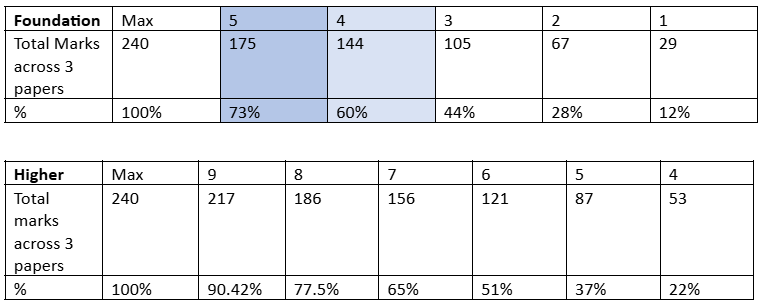
To put this into perspective, roughly 800,000 students sit GCSE Mathematics each year. Across the country, the spread of grades usually looks like this:

What Do These Numbers Actually Mean for Revision?
How can you use these statistics to plan effectively? What type of questions does your child need to excel at to achieve their target grade?
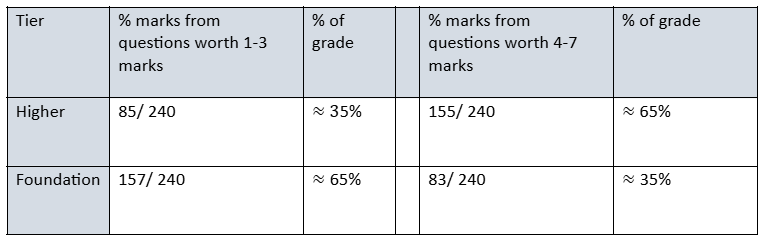
It all comes down to how the papers are built. Here is a breakdown of where the marks actually live in the exams:
Digging Deeper: The Higher Paper
The Grade 7 Reality (156 marks): In theory, a Grade 7 result could sit almost entirely within the 4-7 mark questions. While students don't need to get all of these perfectly correct, it proves a vital point: you cannot reach a Grade 7, 8, or 9 just by being "good at the first half of the paper."
The Grade 6 Reality (121 marks): Even if a student scores almost full marks on all the short 1–3 mark questions, they will still need to pick up a significant chunk of marks by attempting the big, multi-step questions. This explains why I often hear students say, "The first half felt fine, but the second half wasn't what I expected... and neither was my grade!"
Digging Deeper: The Foundation Paper
The Grade 5 Jump (175 marks): To achieve a Grade 5 (a strong pass) on Foundation, a student needs 73% of the paper. Short questions alone simply aren't enough. Students must engage with multi-step questions. This is why aiming for a Grade 5 feels like such a steep jump.
The Grade 4 Baseline (144 marks): Foundation students can achieve a Grade 4 (the standard pass) with solid basics. However, nearly 40% of students sitting GCSE Maths each year fall below a Grade 4. Falling short often happens because students struggle to pick up those vital method marks on the 4-mark questions.
Bridging the Gaps: Moving Up a Grade
Foundation: Moving from Grade 4 to Grade 5
Grade 4 students can typically answer most short questions, use basic methods correctly, and pick up early marks.
To reach a Grade 5, students must also:
Handle multi-step problems without freezing.
Combine topics (e.g., answering a question that mixes ratio with percentages).
Explain their reasoning clearly.
Avoid giving up when unsure.
The jump to Grade 5 isn't about learning "harder maths"; it’s about better structure and persistence.
Higher: Moving from Grade 6 to Grade 7
Grade 6 students generally know the content and answer straightforward questions correctly, but often lose marks on longer, complex problems.
To reach a Grade 7, students must also:
Secure method marks even when their final answers aren’t perfect.
Set out their working logically.
Choose efficient strategies to save time.
Stay calm when faced with unfamiliar wording.
The jump to Grade 7 isn't necessarily about extra knowledge, it’s about clear exam thinking and well-rehearsed strategies.
Busy Revision vs. Effective Revision
Many GCSE students revise by doing lots and lots of short questions. It looks busy. It feels productive. But are they actually improving where it counts?
GCSE Maths marks are not awarded for how many questions you attempt before an exam. The exam heavily rewards how well a student handles the bigger 4-7 mark, multi-step questions. These are the questions that require thinking, structure, and resilience.
That is why revision needs to focus less on speed and volume, and more on deep understanding, chasing method marks, and setting out clear working.
Busy revision ≠ effective revision. Targeted practice earns vital marks.
