

Why students lose marks even when they “know the maths”
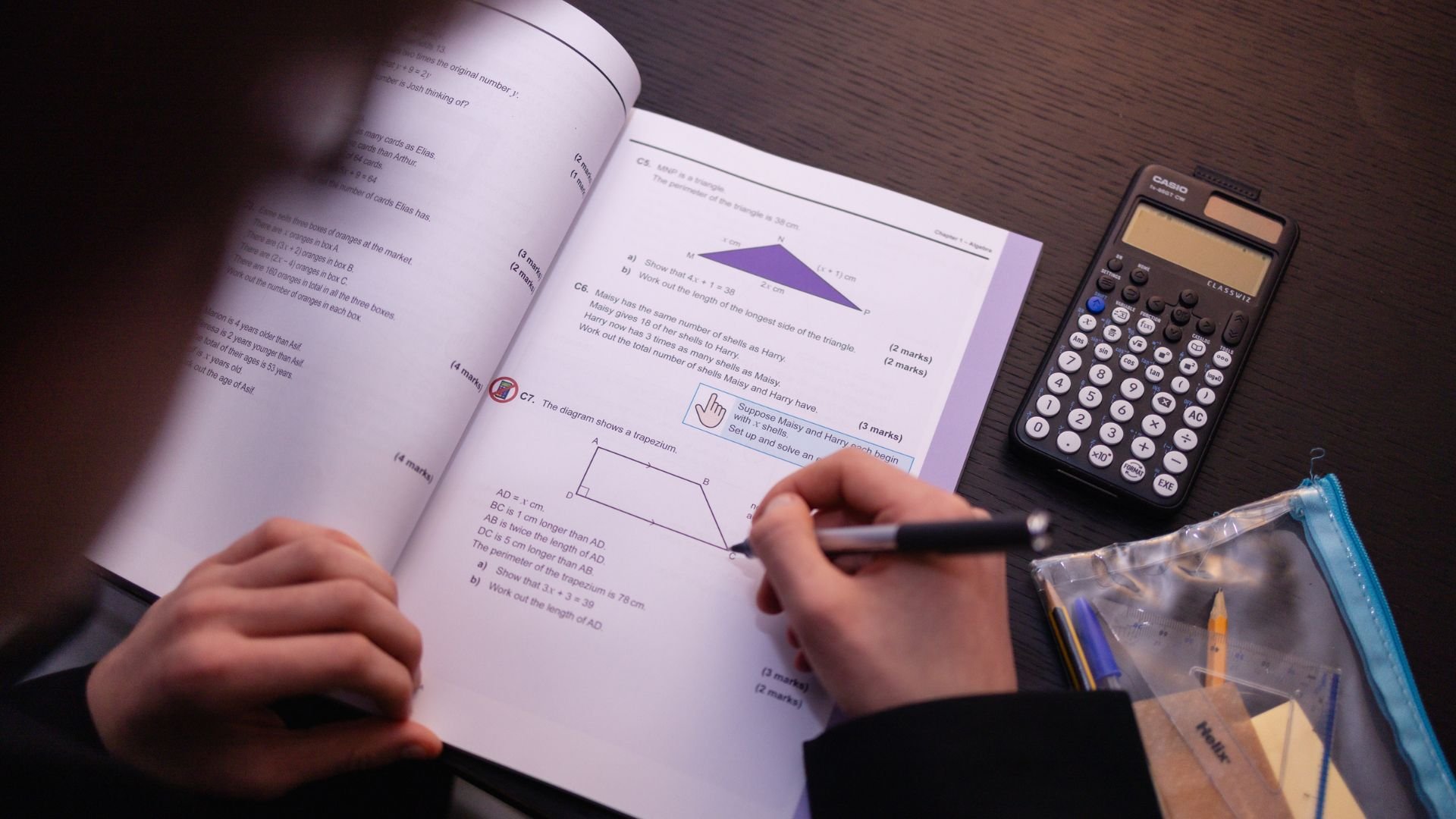
If you teach maths, tutor students, or help your child with maths homework and revision, how many times have you heard comments like these?
“I don’t even know where to start.”
“I’m fine with questions that tell me what to do, but I don’t understand these worded questions. Is this even maths?”
“I’m fine in lessons, but in exams I freeze and always lose marks on the big questions.”
“If I’d known it was asking me to do that, I would have done it!”
“We were never taught this at school.”
“I left that question, I’ve never seen anything like that before.”
If you’re nodding along, you’re not alone. I hear these comments almost every day I teach. It is nearly always the multi-step problem-solving questions that cause this type of response, the ones at the end of homework or in the second half of an exam paper. These are the questions that really boost your grades and so can be very important. The funny thing is, students often know the maths, yet still struggle to access the marks as they do not know how to apply what they know.
So why does this happen?
Based on my teaching experience, here are ten common reasons and what students can do about them.
1. Focusing on the Answer Instead of the Process
Many students approach maths with one goal: get to the answer as quickly as possible. When they can’t see it immediately, they panic.
Advice:
Shift your focus away from the final answer and onto the process.
Think of a multi-step question like a 1,000-piece puzzle. You know it forms a picture, but you don’t start with the full image. You look for small connections, two pieces that fit, then a third, then a fourth. Each small step matters.
Solve what you can see. You build towards the final answer, only by answering the small questions and steps first.
2. Freezing When the Links Aren’t Obvious
When the clock is ticking and nothing seems to connect, anxiety takes over.
Advice:
Pause and identify the topic and context. Break the question down into manageable chunks.
Ask yourself:
What area of maths does this belong to? Sequences, algebra, averages?
What is the question really about, and what I am being asked?
How would I explain it to my younger sibling or cousin?
For example, if the question talks about tiling a room, you are probably finding the area of the room. That’s your starting point. Then break the question down to bitesize chunks… .
Write down the formula.
Identify the shape (rectangle, square, trapezium?).
Insert the numbers carefully.
Check your units (m², cm²).
Then return to the question and look for the next step.
In an exam, if you’ve spent around one minute per mark (e.g. 5–6 minutes on a 5-mark question) and you’re stuck, move on.
At home, leave it and come back later. Often clarity comes with time.
3. Checking the Solutions Too Quickly
This is something I’ve done myself as a teacher and I see students do it all the time.
They attempt a question, check the answer immediately, see it’s wrong, glance at the solution and say:
“Oh yes, I get it now.” And move to the next question.
Do they really get it? To the extent that they will score significant marks – remember that the answer is often only 1 mark on big questions. Even if the answer makes sense, what skill did they practise when checking a ready made answer? Will they be able to solve a similar question independently?
Advice:
Allow yourself to be stuck. Struggle is not failure. It’s part of the learning. As adults, we grow through challenges and difficulties. As students, we grow mathematically in exactly the same way.
Sometimes it takes hours. Sometimes it takes days. Solving 80% of a problem independently over two days teaches far more than being shown the answer in two minutes.
I observed this repeatedly when I spent time in Japanese classrooms. Teachers allowed students to remain stuck, offering support through questions — but never giving the answer. In one lesson, students struggled for over 30 minutes before the breakthrough came. The confidence they gained from this was remarkable.
This approach is one reason Japanese students are considered to be so strong at solving unfamiliar problems — often in multiple different ways.
4. Underestimating How Long Learning Takes
We live in a fast world, yet we expect students to master problem solving in an hour between PE and meeting friends on a Friday night.
Advice:
There are no shortcuts. Aim to practice:
5 –10 multi-step questions per week, or
1 –2 per day, giving yourself a full hour/ day when possible.
Try. Get stuck. Try again tomorrow. Revisit your notes. Remind yourself of key formulas.
I often tell students: we can watch Cristiano Ronaldo score a goal and understand what he’s doing, e.g. finding space, timing his run, striking the ball. But does that mean we can do it?
Of course not.
He’s spent thousands of hours practising. Understanding is not the same as being able to perform. Only practice gives you that chance.
5. Not Writing an Answer Because You’re Unsure
Some students do the work, get an answer… then cross it out because they’re not confident.
Advice:
Trust yourself. Don’t cross out an answer unless you genuinely have something better.
Never write two different answers! You’ll get no marks at all.
What’s the worst that happens if it’s wrong?
Nothing. You learn.
6. Trying to Memorise Methods Instead of Understanding
Students often ask:
“Are all these questions the same? Do I always do the same thing?”
Advice:
Stop memorising procedures. Start understanding. Take the time to really “get” it. Practice different styles of questions that test and probe areas you may not fully get.
In maths, a single word, number, or variable can completely change the problem. Focus on what you’re doing and why.
Ask questions. There is no such thing as a silly one.
7. Losing Marks for Poor or Missing Workings
“I got 2 out of 5 marks! I didn’t show my workings!”
Advice:
Show your workings clearly and logically. Always.
Write from left to right, top to bottom.
Don’t scatter calculations around the page.
Remember: the examiner’s job is to mark your work, not hunt for it.
Always state what you are finding. The marker should see your thinking, not have to look for it or guess at what you may have been thinking.
8. You Don’t Know How to Practise Problem Solving
“I don’t see many problem-solving questions in lessons.”
Advice:
a) Use past papers
Choose papers for your course (e.g. GCSE, A Level), and practise the higher-mark questions, often found in the second half.
b) Use targeted books
Books that focus on problem-solving, like the Exam Mastery Series, to prepare students for the kinds of questions that appear in real exams.
9. You Think “I Always Get These Wrong”
Students often say:
“What’s the point? I always get them wrong.”
Advice:
Reframe mistakes. A mistake or error is an opportunity to learn and grow, to master your knowledge and reinforce learning.
For example, each question worth 5 marks gives you 5 opportunities to improve. For opportunities to demonstrate how much you know.
Ask yourself:
How many marks can I secure?
What clues are already in the question?
Can I read it one more time?
Every attempt builds skill.
10. You Don’t Take Time to Reflect
Reflection is one of the most under-used learning tools. In my lesson students always spent the last five minutes reflecting:
How did I solve it?
Is there a different way?
What did I get wrong?
Why did I get it wrong?
What did I learn?
Keep a reflection notebook. Record challenging questions, your solutions, mistakes, and insights. Over time, patterns emerge — and so does progress, learning and ability.
I hope this has reassured you that if your child or student is getting stuck in some areas, too scared to try and fail, or they feel like they are taking too long to learn something, there are ways you can support them.
Students don’t lose marks because they can’t do the maths. They lose marks because problem solving is a skill! And like all skills, it takes time, strategy, and practice to develop.
With patience, reflection, and deliberate practice, any student can grow stronger and more confident in tackling multi-step maths problems.
